You can run a team, close a deal, finish a shift, teach a room, lead a board meeting—and still walk into your own kitchen feeling like a competent stranger.
The house runs. The kids get where they need to go. Nobody is throwing plates. And somehow the marriage feels… efficient. Thin. Like a well-managed joint venture with a roommate you respect.
You are not broken for noticing that. You are paying attention.
The skill that wins at work can lose at home
At work, speed is a virtue. So is problem-solving. So is staying unemotional enough to make the call. Those skills pay the mortgage. They also train a nervous system that treats every conversation like a ticket queue.
Your partner says something about the day. You hear a problem. You offer three solutions. They did not want a solution. They wanted you.
Or the reverse: you come home emptied out, and the smallest request feels like another meeting after hours. You go quiet. They feel alone next to you on the couch.
Neither story needs a villain. Both need a mode switch.

Why home goes flat (and the antidotes)
Why: You bring the wrong dashboard through the door
Leaders track metrics. Parents track logistics. High performers track the next unfinished thing. Marriage does not run on that dashboard. Connection runs on bids—small reaches for attention, humor, help, or affection—and on whether those reaches get turned toward, away, or against (another Gottman idea that matches what couples feel in their bones).
If your default at 6:40 p.m. is optimize-and-clear-inbox, your partner's "how was your day" lands as noise. You are not cruel. You are still at work in your head.
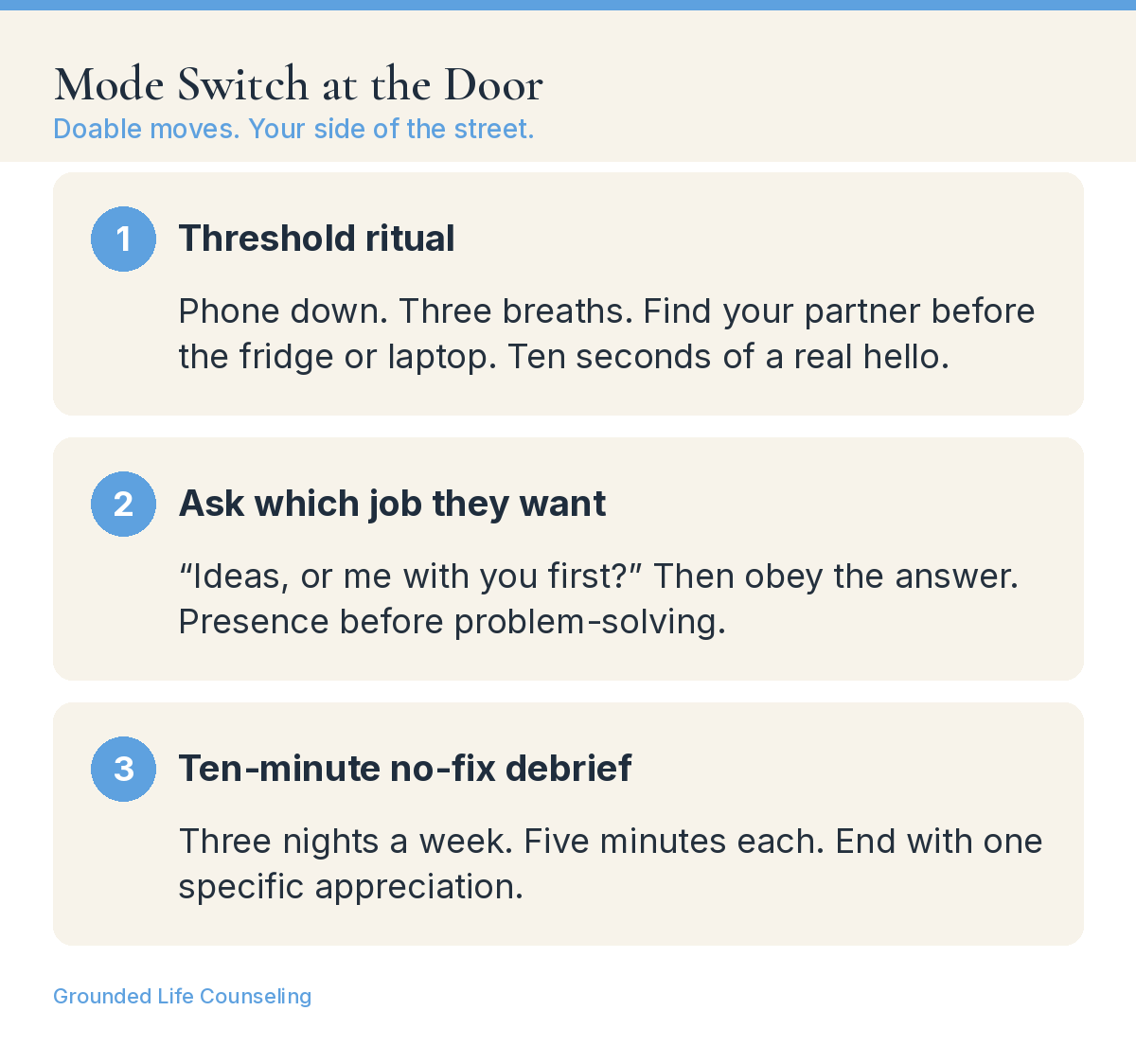
Antidote — A two-minute threshold ritual. Before you fully enter the house—driveway, garage, front step—pick a physical reset: phone face-down in a bowl, shoes off, one glass of water, three slow breaths. Then find your partner before you find the fridge or the laptop. Ten seconds of eye contact and a real hello beats a forty-minute "quality time" you never actually start.
This is not romantic theater. It is a mode switch. Your body needs a cue that the dashboard changed.
Why: Solve-mode steals the conversation
When someone you love is upset, your competence wants to help by fixing. Fixing can feel like love to you and like dismissal to them. They feel managed. You feel unappreciated. Flatness deepens.
Antidote — Ask which job they want you in. One question, early: "Do you want ideas, or do you want me with you first?" Then obey the answer. If they want you with them, your only job for a few minutes is reflection and presence: "That sounds heavy. I'm glad you told me." Solutions can wait. Often they evaporate once the person feels accompanied.
If you are the one who needs to vent, say it up front: "I don't need a fix—I need ten minutes to unload." That one sentence saves both of you from a fight about help that was never requested.
Why: Efficiency starves fondness
Busy couples in North Richland Hills and across DFW are excellent at logistics. Carpools. Travel. Church. Sports. Aging parents. The calendar is a masterpiece. Fondness is what gets cut when the masterpiece runs late.
Gottman's work on friendship in marriage is not soft fluff: couples who stay strong keep a living sense that they like each other, not only that they function. Flatness is often fondness debt.
Antidote — A ten-minute no-fix debrief, three nights a week. Sit. Phones away. Each person gets five minutes. The listener does not problem-solve, defend, or steer. Prompt options: What was the best part of your day? What was heavy? Where did you feel alone? End with one specific appreciation: not "thanks for everything," but "I noticed you handled bedtime so I could finish that call—thank you."
Ten minutes is short enough to survive a real week. It is long enough to remind your nervous systems you are on the same team.
They did not want a solution. They wanted you.
Coach your moves—not their personality
It is easy to turn flatness into a story about your partner: they're needy, they're distant, they're never satisfied. That story feels sharp. It also keeps you from changing the only person you can reliably change tonight: you.
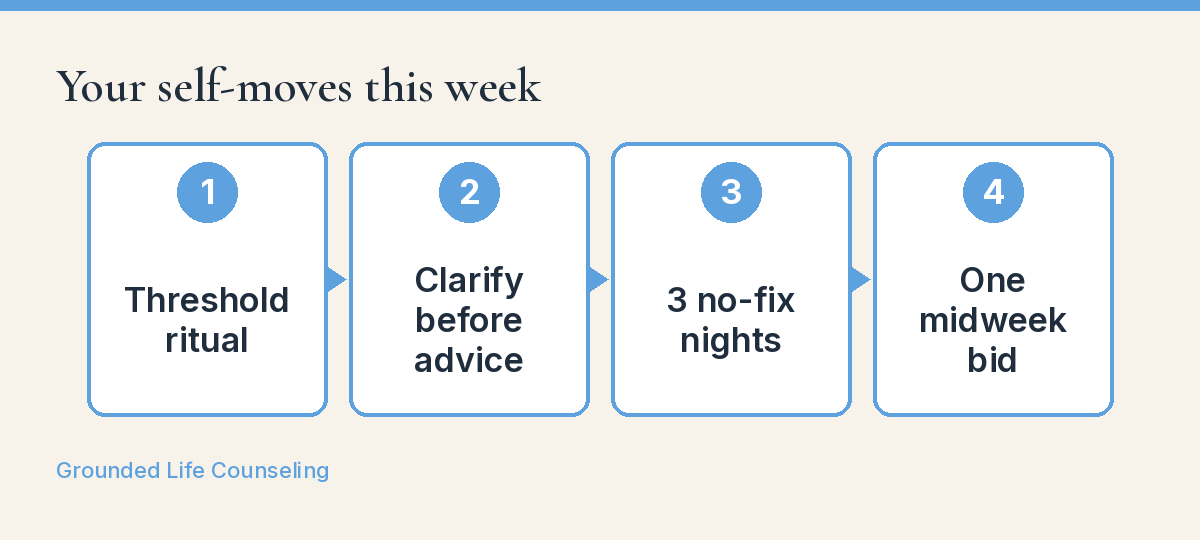
Try these self-moves for a week: 1. Threshold ritual before the fridge. 2. One clarifying question before advice. 3. Three no-fix debriefs. 4. One midweek bid you initiate—a walk, a stupid meme, a "sit with me on the porch for five."
If you usually walk on eggshells to keep the peace, or you keep having the same fight in different clothes, those patterns often sit underneath the flat feeling. Browse the blog for those deep dives.
Flatness is often fondness debt—and fondness is rebuilt in minutes, not in a future vacation you never take.
For the partner who feels invisible next to a high performer
Maybe you are not the one crushing it at work. Maybe you are the one who keeps the household breathing while your spouse's career takes the spotlight—and you feel flat because you are useful but not chosen.
Your antidote is not to compete with their job. It is to make a clear bid and a clear request: "I don't need you to quit caring about work. I need you to come find me before the laptop. Can we protect 9:00–9:15?" Specific beats vague. Vague invites more efficiency. Specific invites a yes.
And if you are the high performer reading this: treat that request as a priority meeting with the most important person in your life—not as optional overflow.
The honest limit of self-coaching
These moves help a lot of capable couples. They are also harder than they look when your body is still keyed up from the day, when resentment has a five-year head start, or when every bid feels risky because the last ones went badly.
Emotional flooding—heart rate up, thinking narrowed—makes "just be present" feel impossible. That is not a motivation problem. It is a nervous-system problem. Skills work better when someone helps you slow the pattern enough to use them.
Beth and I work with leaders, physicians, owners, pastors, and other people who are good at hard things and tired of a marriage that only works on paper. Faith-friendly, research-informed, no preaching. If you want the practical side—time, structure, cost—see Program & Fees or reach out.
If this sounds familiar, a free 10–15 minute call is a good place to start: text (682) 376-4390 or book a time.