You could script the next twenty minutes.
Someone mentions the dishes, the calendar, the tone of a text, the way the other one "checked out" after work. A familiar heat rises. One of you presses. One of you pulls away—or presses back harder. Twenty minutes later you are exhausted, a little ashamed, and nowhere new.
The topic changed. The dance did not.
That is not proof you married the wrong person. It is proof you have a loop.
The fight is rarely about the thing you are fighting about
Most couples who are good at hard things are confused by this. At work you solve problems. You escalate when something matters. You expect a clear owner and a clear next step. At home the same instincts can light the same fuse every Tuesday.
John Gottman's research on couples made a blunt, useful distinction that still holds: many conflicts are perpetual. They are rooted in lasting differences—pace, neatness, social energy, money anxiety, how close is close enough. You will not "close the ticket." You can learn to talk about the difference without torching the evening.
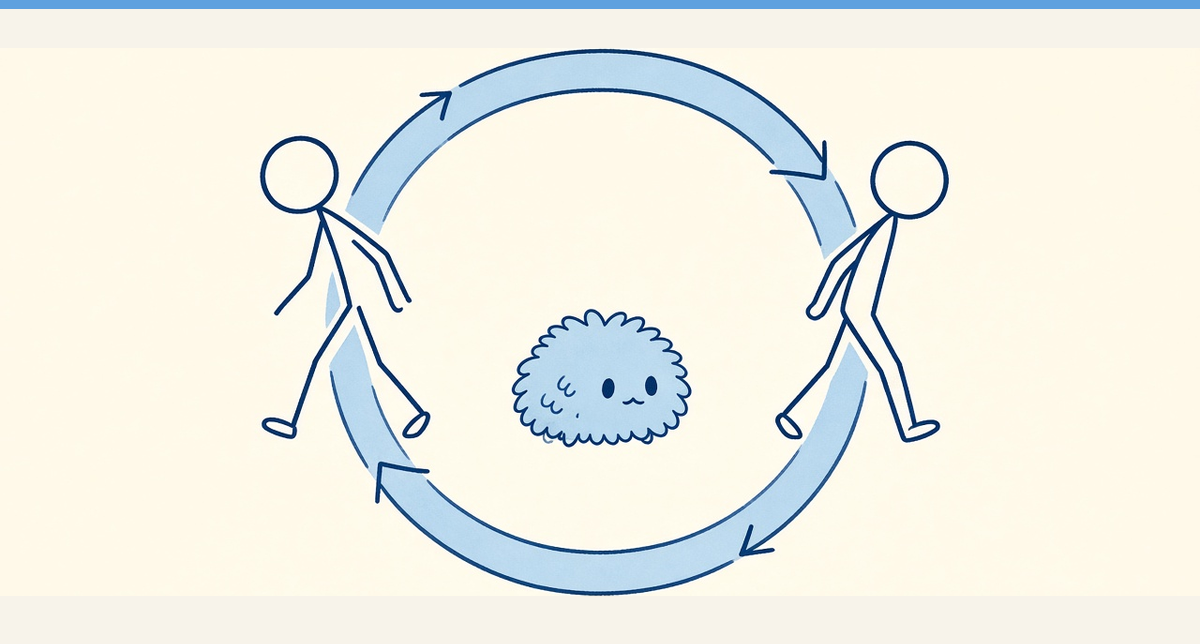
Why the loop keeps winning
Why: Pursue and withdraw are a team sport
One of you moves toward the problem (questions, volume, "can we please deal with this"). The other moves away (quiet, logic, phone, garage, "I can't do this right now"). Each move makes sense alone. Together they tighten the loop.
The pursuer feels abandoned and turns up the volume. The withdrawer feels flooded and turns down the presence. Neither of you is the villain. The loop is what keeps winning.
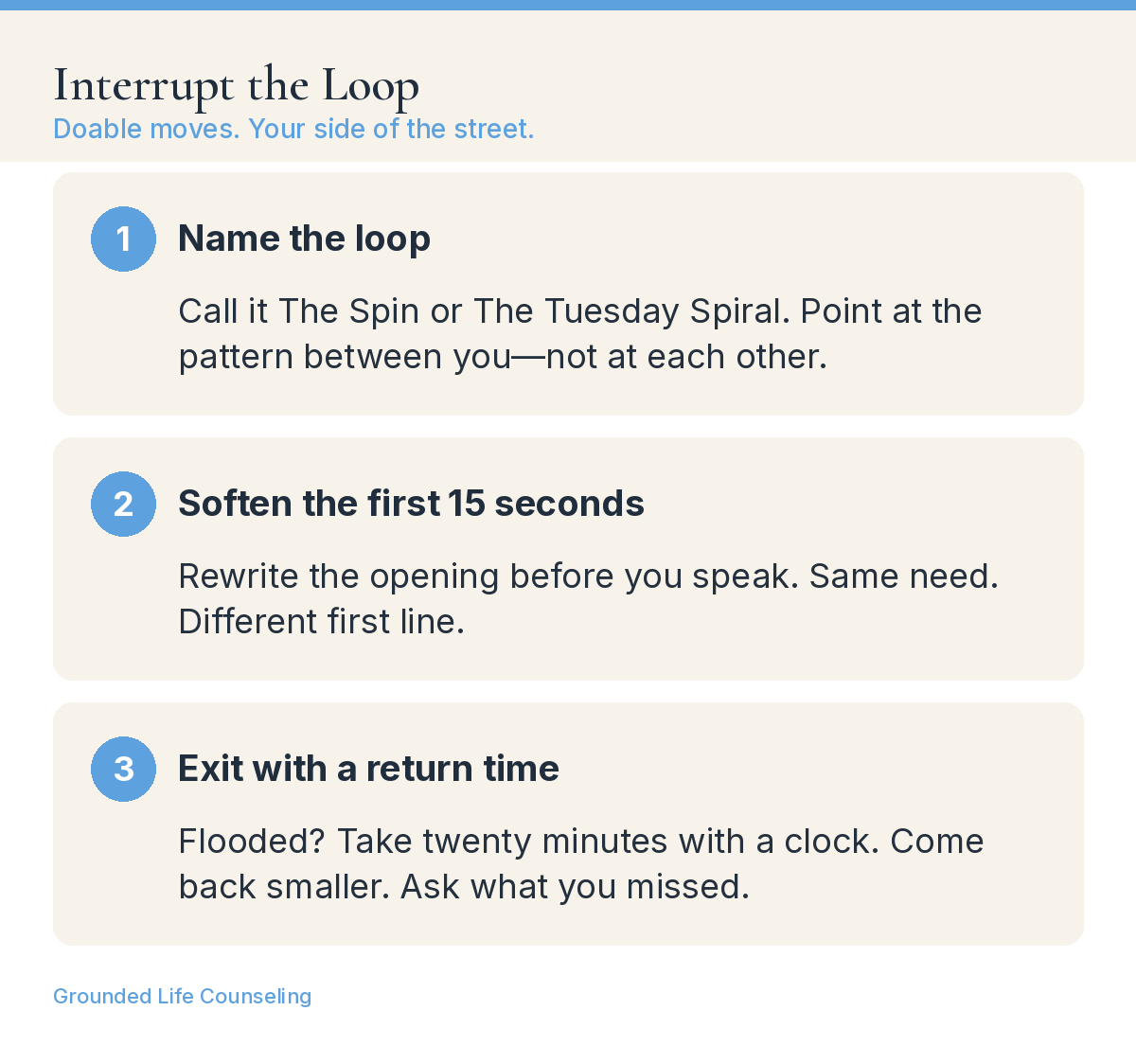
Antidote — Name the loop out loud, as a team. Pick a short, slightly ridiculous name: The Spin. The Tuesday Spiral. The Dishes Opera. Then practice one sentence when it starts: "Hey—I think The Spin just walked in. Can we slow down before we feed it?"
You are not diagnosing your partner as "the pursuer" or "the avoider" in a courtroom voice. You are pointing at the pattern between you. Externalizing the cycle is an Emotionally Focused Therapy idea for a reason: it moves blame off the person and onto the dance.
Why: Hard startups guarantee hard replies
If the opening line is a prosecution—"You never… You always… Why can't you just…"—the other person's nervous system hears danger, not data. Defensiveness is then not a personality quirk. It is a shield.
Antidote — Soften the first fifteen seconds. Rewrite the opening before you speak:
Instead of "You never help at bedtime," try: "I feel overwhelmed at bedtime, and I need us to split the last thirty minutes on purpose."
Instead of "You're on your phone again," try: "I miss you at night. Can we do twenty minutes with phones in the other room?"
Same need. Different first fifteen seconds. That window is where most of the fight is won or lost.
Why: Flooding turns adults into bad lawyers
When heart rate spikes, nuance drops. You stop listening for what your partner means and start listening for ammunition. This is flooding—diffuse physiological arousal, in Gottman language—and it is why "we just need to communicate" fails at 10:40 p.m.
Antidote — Exit with a return time, then come back smaller. Say: "I want to stay with you on this. I'm flooded. Twenty minutes—back at 9:05." Walk. Water. No closing argument in your head. When you return, start with one soft sentence and one question: "What did you need me to hear that I missed?"
A break without a return time feels like abandonment. A break with a clock is how you protect the relationship from the worst fifteen minutes of your day.
Neither of you is the villain. The loop is what keeps winning.
Depth without diagnosing
Here is a zinger worth keeping on the fridge: insight without a next move is just a more articulate stuck.
It feels productive to analyze why your partner "does that." It rarely changes Tuesday night. What changes Tuesday night is a different move from you—softer open, named loop, timed break, faster repair.
Repair sounds like: - "I came in hot. Let me start over." - "I disappeared. I'm back. Can we try again?" - "I made you the problem. I don't want that."
Repair is not weakness. Repair is how competent people refuse to let one bad half-hour write the whole week.
A one-week experiment for a busy DFW calendar
You do not need a retreat to start. You need one intentional week between school runs, 635 traffic, and whatever your job demands.
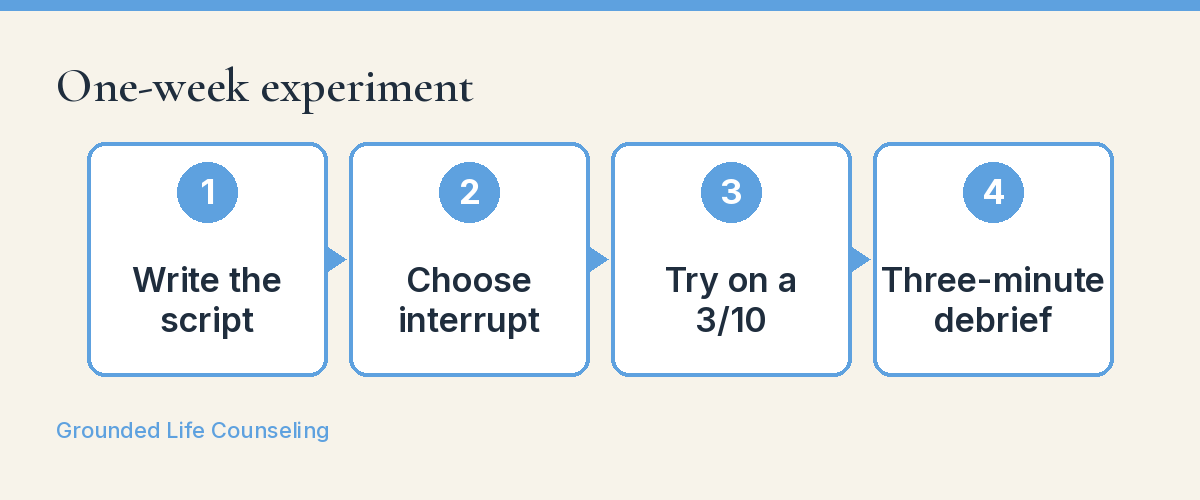
Write the script. Alone, jot the usual sequence in five lines. Where do you always enter?
Choose your interrupt. Loop-name, soft start, or timed break. One interrupt is enough.
Run it once on a 3/10 topic. Do not debut this on the marriage-defining fight.
Debrief for three minutes. "What worked? What should we try differently?" No scorekeeping.
If eggshells are part of your half of the dance—holding back to keep the peace—read Why Walking on Eggshells Is So Tiring next. Same theme, other door.
Insight without a next move is just a more articulate stuck.
What "winning" the fight actually costs
High performers hate losing. So the loop becomes a contest: who has the better evidence, who is more reasonable, who cares more. Even when you "win," you often lose the evening, the warmth, and the willingness of your partner to bring you the next hard thing.
Trade the win for a clearer need. Before you re-enter the conversation, write one sentence that starts with "I need…" not "You should…" Needs can be negotiated. Indictments cannot.
If your half of the loop is tiptoeing rather than pressing, the same principle holds: the goal is not to become louder. The goal is to become clearer without lighting the fuse.
When the loop is older than your willpower
Some couples can interrupt The Spin with these moves and feel the room change within a few weeks. Others find the loop is so practiced that every soft start still gets pulled into the old choreography—or that one of you cannot take a break without the other panicking.
That is not a failure of character. Patterns that took years to build often need a structured space to slow down: two people, no sides taken, enough time to practice new moves while someone helps you catch the loop in real time.
Beth and I meet couples in North Richland Hills who are excellent at work and tired of rehearsing the same fight at home. See who we are or how Program & Fees work if you want the practical details—no pressure, just clarity.
If this sounds familiar, a free 10–15 minute call is a good place to start: text (682) 376-4390 or book a time.