You know the quiet that isn't peace.
Before you speak, you check the room. Is this a good time? Will it start something? So you soften it, shorten it, or skip it.
The house stays calm.
You're exhausted, and nobody even yelled.
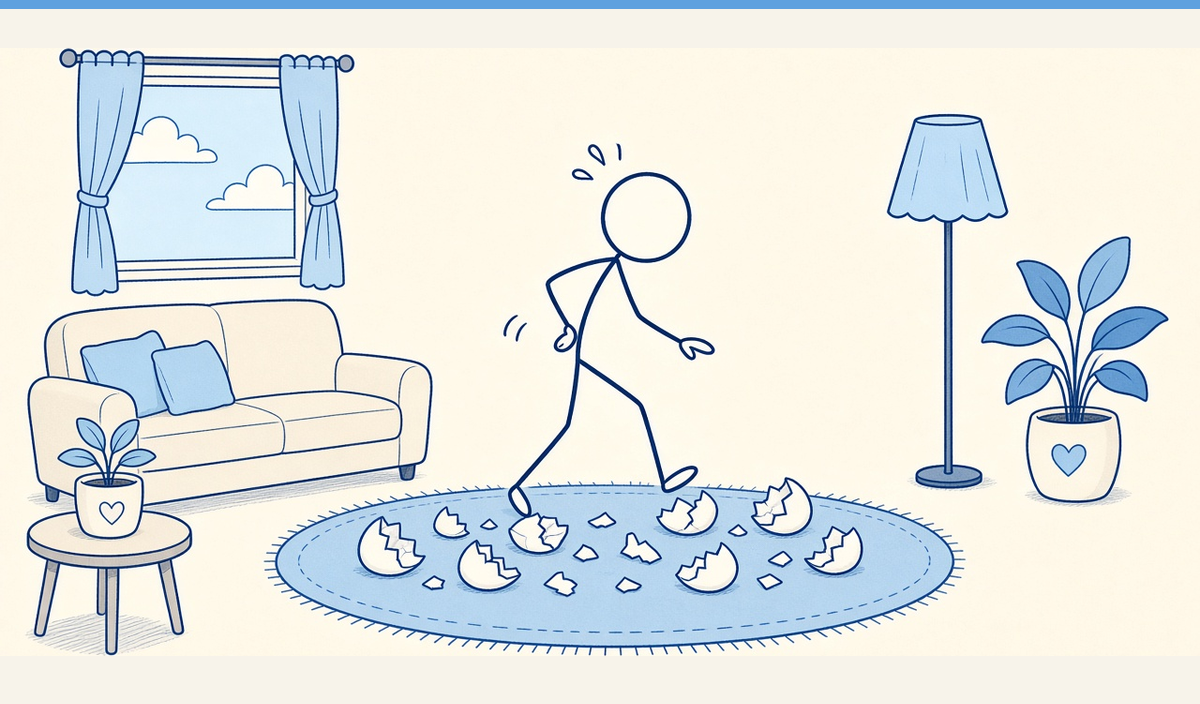
Eggshells feel like care. They aren't closeness.
Eggshells can feel like love: if I don't rock the boat, we'll be okay. Often that impulse is protective. You are trying to keep the evening from tipping over. You are trying to protect the kids' bedtime. You are trying to protect whatever scrap of goodwill is left after a long week.
But calm is not the same as closeness.
A home can have no arguing and still be thin on honesty—what you really think never quite gets said. The bills get paid. The calendar stays full. The marriage starts to feel like a well-run project with a quiet roommate.
Why it happens (and what to do instead)
Why: Your nervous system is trying to keep you safe
When a conversation has gone badly enough times, your body learns the shortcut. Heart rate up. Shoulders tight. Words get smaller. You edit yourself before the first sentence leaves your mouth.
That is not a character flaw. It is a protective move. The problem is that the move that keeps the peace also keeps you from being known.
Antidote — The 10-second check. Before you swallow the true thing, pause and name (silently) what you are protecting: their mood, my energy, the kids hearing us, another late-night spiral. Naming it to yourself does not fix the marriage. It does stop the autopilot for one beat. That beat is where a different choice becomes possible.
Why: Softening every hard thing trains both of you
If you always sand the edges off what you need, your partner never gets a clear signal. They meet a quieter version of you and fill in the blanks—often wrong. You feel unseen. They feel shut out. Less conflict arrives; more connection does not.
This is a pattern between two people, not a verdict on either of you. (If what you are facing is intimidation or control meant to keep you small, that is not a pattern to balance—it is a safety issue, and the work looks different.)
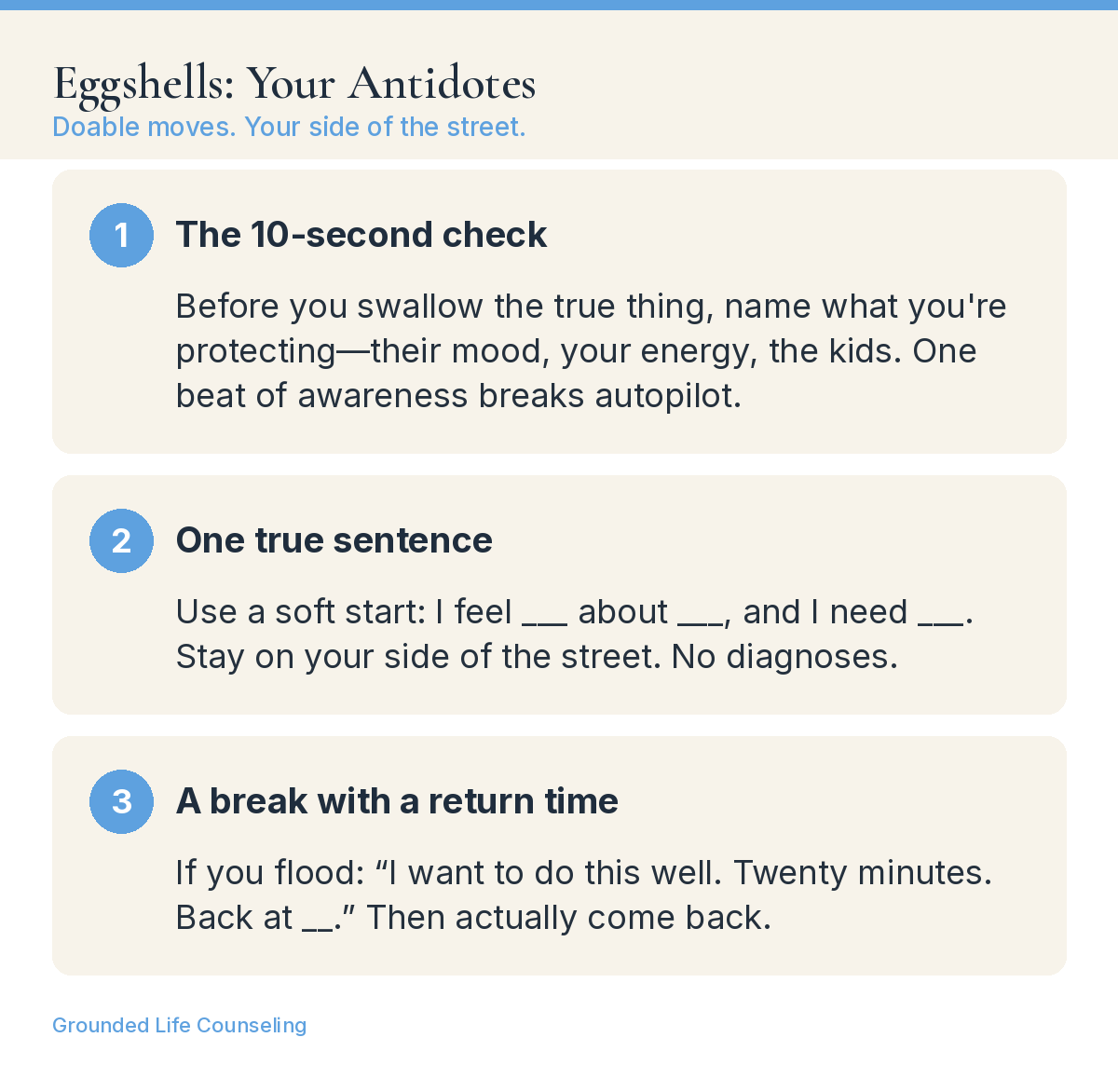
Antidote — One true sentence, soft start. Pick one low-stakes true thing this week. Not the whole marriage. One sentence.
Use a soft start (a Gottman idea that holds up in real kitchens): I feel ___ about ___, and I need ___.
Examples that stay on your side of the street: - "I feel lonely when we scroll through dinner, and I need twenty minutes with phones down." - "I feel tense bringing up money late at night, and I need us to pick a weekend morning instead."
Notice what you did not do: diagnose their personality, rehearse their failures, or open with "you always."
Why: Flooding makes good skills disappear
Here is the honest part most advice skips.
When your body is flooded—heart racing, mind narrowing—the soft-start sentence you practiced in the car will not be available. Limbic activation is not a moral failure. It is biology. Skills that look obvious on a blog get hard in the moment.
So the antidote is not "try harder while your pulse is at 110." The antidote is to stop before the worst version of you shows up.
Antidote — A break with a return time. If you feel yourself tipping into eggshell mode or into snapping: say, "I want to do this well. I need twenty minutes. I'm coming back at __." Then actually come back. A break without a return time is just another disappearance. A break with a clock is care.
Walk. Drink water. Do not rehearse your closing argument in the garage. The point of the break is to bring your thinking brain back online so you can use the soft sentence—not to win.
Calm is not the same as closeness. A quiet house can still be a lonely one.
What not to do (this is where couples get stuck)
Do not turn this post into a case against your partner.
Eggshells are tempting to diagnose: they're too sensitive, they're the angry one, they're unreachable. That lens feels clarifying for about five minutes. Then it becomes another reason to hold back—or another reason to prosecute.
Coach yourself on your moves, not their diagnosis.
Your job this week is not to fix their reactivity. Your job is to stop disappearing from your own life in your own house.
A practical week, not a personality transplant
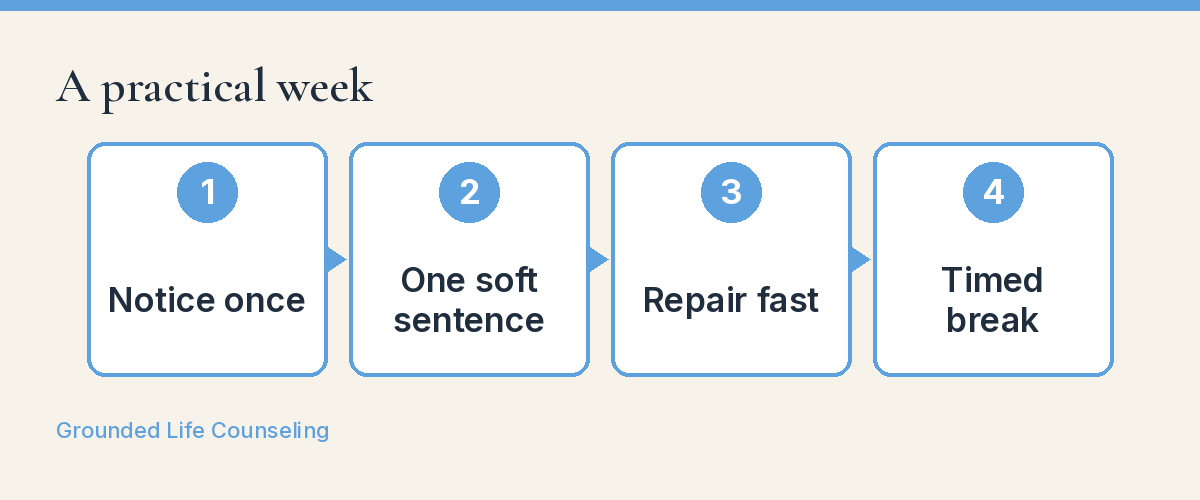
Try this sequence. Keep it small enough that a busy DFW week can hold it—school drop-offs, traffic on 820, late meetings included.
Notice once. Catch one moment you almost said the true thing and didn't. Write what you were protecting. No fixing yet.
Say one soft sentence. Use the I feel / about / I need shape. Pick a topic under a 3 out of 10 on the conflict scale.
If it goes sideways, repair fast. "That came out sharper than I meant. Can I try again?" Repair is not losing. Repair is how adults keep a hard conversation from becoming a cold week.
If you flood, use the timed break. Come back. Do not white-knuckle a talk your body has already left.
Your job this week is not to fix their reactivity. It is to stop disappearing from your own life in your own house.
When "just communicate" is not enough
Some couples can take these moves and feel air return to the room within a few weeks. Others find that the eggshells have been down so long that every true sentence still lights the fuse—or that one of you cannot come back from a break without the other panicking.
That does not mean you failed the blog homework. It means the pattern is bigger than willpower, and a structured conversation with someone who will not take sides can slow the cycle down enough for these skills to stick.
Beth and I work with couples in North Richland Hills and across the DFW area who look steady from the outside and feel careful on the inside. We are practical. We are faith-friendly without preaching at you. We care more about what you do next than about labeling who is broken.
If you want more on this theme, start with the other posts on our blog, or see how sessions work on Program & Fees.
If this sounds familiar, a free 10–15 minute call is a good place to start: text (682) 376-4390 or book a time.